


O | OCCUPATION
Description
“We lost our home, which means the familiarity of daily life. We lost our occupation, which means the confidence that we are of some use in this world. We lost our language, which means the naturalness of reactions, the simplicity of gestures, the unaffected expression of feelings…our best friends have been killed in concentration camps, and that means the rupture of our private lives.” — Arendt, We Refugees (1943).
What of oneself is lost—dispossessed—when one is possessed, owned and abandoned at the same time, by an occupier? Few thinkers open up the abyss of alienation that sprawls under the experience of occupation like Hannah Arendt. Contrary to what modern jurisprudence hangs its understanding of occupation on, for Arendt, the loss of home to conquest and “total domination” means not only a loss of land or territory but also an evisceration of one’s most private self—one’s sense of use in the world—so profound that occupation can mean nothing less than a total rupture, a borderless crime.
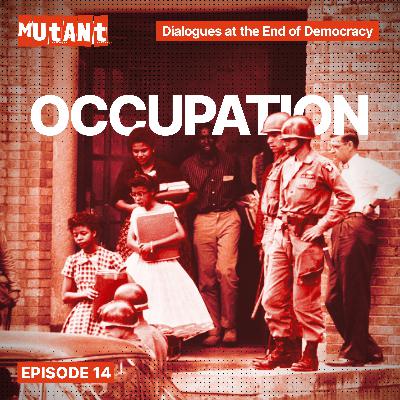
Occupation is a colonial war without end, says Aishwary Kumar. “But it is not colonial only. It is a demolition of the mundane, a segregation so immovable that even the most routine acts—like Elizabeth Eckford’s resilient walk to a high school in Little Rock in her own town and country in 1957, surrounded by National Guard troops in Arkansas—feel like a crime. Were the troops that day protecting Eckford and her fellow students who became the heroic Little Rock Nine or were they reminding Black America of the sheer immovability of their old life even after the schools had been desegregated?”
This is the vaporous heart of the history of occupation. So pervasive is it as a colonial, theological, and racial phenomenon that its ubiquity obscures from us a simple truth: that occupation, despite its violence and barbarism, is profoundly ambiguous in its form, structure, and effects. In that, it mirrors violence, without which it cannot be thought.
Like violence, occupation is an anti-concept. And like violence, rather than helping us understand our political history and moral present systematically, it splinters our time—and our judgment—into a hundred pieces.
“Occupation is not simply a military paradigm that leaves boot marks,” Aishwary reminds us. “It is a bearer, as W. E. B. Du Bois would say, of our double consciousness, as if we were moving freely, earning our livelihoods and performing our duties freely, right in the middle of a colonial disaster. A hesitation that hangs on my skin and in the air around me like a militarized punctuation.”
Occupation is someone’s control given the indifferent masquerade of skill. Occupation teaches the occupied subject the skills to live and earn and survive, they say. Occupation is thus like caste, which in turn—and not by chance—is the oldest theory of occupation. “Even though caste looks simply like a practice of occupations,” Aishwary suggests, “caste is a nodal theory of occupation, because caste occupies and steals time itself. Where colonial occupation is a question of breadth and expanse, caste occupation is a question of depth and verticality, stretching generations. Where colonial occupation is a question of territoriality, caste occupation is a function of temporality.”
Our episode on Occupation is perhaps Mutant’s most primal: rather than approaching occupation as a military concept, we deconstruct its strange political stability. We ask not what makes occupying forces so barbaric but instead what makes occupation so immovable? And what might become possible were it to be harnessed as a democratic strategy, an anchor for encampment, a new politics of immovability?





 United States
